Most people focus on the home's price tag. The real cost is often much larger. On a typical 30-year mortgage, you can pay anywhere from 50% to over 100% of the original loan amount in interest alone.
Run the numbers with the free mortgage calculator on ezcalcs, then come back to this guide for context. Results are estimates for planning only.
This guide breaks down exactly what drives that cost, how to estimate it before you commit, and which decisions can save you tens of thousands of dollars over the life of the loan.
How Mortgage Interest Works Over the Life of the Loan
Mortgage interest is the cost your lender charges for letting you borrow money. It is calculated based on your outstanding balance, not the original loan amount. As you pay down principal, the interest portion of each payment shrinks.
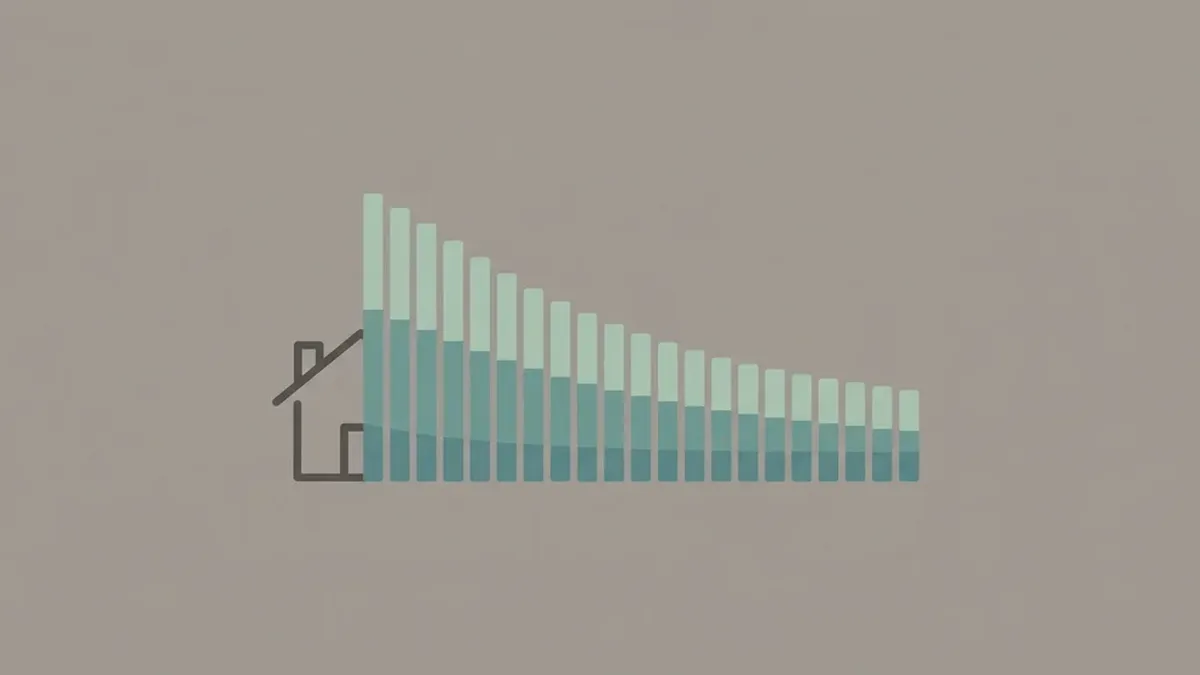
Here is the key concept: in the early years of your loan, most of your monthly payment goes toward interest. Very little goes toward the principal. This flips gradually over time, so that by the final years, nearly all of your payment goes toward the principal.
This pattern is called amortization. On a $300,000 30-year mortgage at 7%, your monthly principal and interest payment is roughly $1,996. Over 30 years, you would pay about $418,500 in interest. That is more than the original loan amount.
Understanding this curve matters because it shapes every strategy for reducing total interest: extra payments, shorter loan terms, and refinancing all work by attacking that front-loaded interest.
What Affects Your Mortgage Interest Rate
Your interest rate is the single biggest lever on total cost. Even a quarter-point difference can mean thousands of dollars in interest over the life of the loan.
Rates are influenced by two categories: factors you control and factors you don't. You control your credit score, down payment, loan type, and loan term. You don't control the Federal Reserve's policy, inflation, or the broader bond market.
How Your Credit Score and Down Payment Affect Your Mortgage Rate
Lenders price risk. A higher credit score signals lower risk, which earns you a lower interest rate. The difference can be dramatic. A borrower with a 760 score might qualify for a rate 0.5% to 1.0% lower than someone with a 660 score.
Your credit readiness matters more than many buyers realize. Could a few months of credit repair or debt payoff drop your interest rate enough to save you a significant amount? Often, yes. On a $400,000 loan, a 0.5% rate reduction saves roughly $45,000 over 30 years.
Down payment size also plays a role. A larger down payment reduces your loan amount directly, which lowers total interest paid. It also signals lower risk to the lender, which can qualify you for better rates. A bigger down payment of 20% or more also helps you avoid private mortgage insurance, removing another cost entirely.
Fixed-Rate Mortgage vs. Adjustable-Rate Mortgage Loan Type
With a fixed-rate mortgage, your interest rate stays the same for the entire loan term. Your monthly principal and interest payment never changes. This makes budgeting predictable.
An adjustable-rate mortgage (ARM) typically starts with a lower rate for an introductory period (often 5, 7, or 10 years). After that, the rate adjusts periodically based on a market index. Your payment can go up or down.
The type of mortgage you choose affects how much interest you pay in different ways:
- Fixed-rate: Higher initial rate, but total cost is known from day one.
- ARM: Lower initial payments, but risk of paying significantly more if rates rise after the introductory period.
ARMs can make sense if you plan to sell or refinance before the adjustment period begins. If you plan to stay in the home long-term, a fixed-rate mortgage usually offers more certainty.
Mortgage Payments on a 30-Year Mortgage
The 30-year mortgage is the most common loan term in the U.S. Its main appeal is a lower monthly payment compared to shorter terms. The tradeoff is substantially more total interest.
How 30-Year Mortgage Rates Shape Your Monthly Mortgage Payment
Your 30-year mortgage rate directly determines what you pay each month and over the full loan term.
Here is a comparison on a $400,000 loan amount:
| 30-Year Rate | Monthly Payment (P&I) | Total Interest Paid |
|---|---|---|
| 5.5% | $2,271 | $417,700 |
| 6.5% | $2,528 | $510,200 |
| 7.0% | $2,661 | $558,000 |
| 7.5% | $2,797 | $607,000 |
A 2-point rate difference on the same loan amount adds nearly $190,000 in interest. These are estimates. Your actual numbers will depend on your specific rate, fees, and payment schedule.
Principal and Interest Payment Breakdown on a Home Loan
Your monthly mortgage payment is split between principal and interest. In month one of a $400,000 loan at 7%, about $1,994 goes toward interest and only $667 goes toward principal.
By year 15, the split is roughly even. By the final years, almost the entire payment reduces your balance. This is why extra payments in the early years have such an outsized impact on total interest, because they reduce the balance that future interest is calculated on.
How Your Loan Amount and Interest Rate Affect Your Monthly Payment
These two inputs drive the math more than anything else. Here are concrete examples:
How much is a $300,000 mortgage at 7% interest? Monthly principal and interest payment: approximately $1,996. Total interest over 30 years: roughly $418,500.
How much is a $500,000 mortgage at 6% interest? Monthly principal and interest payment: approximately $2,998. Total interest over 30 years: roughly $579,200.
How much is a $400,000 mortgage at 7% interest? Monthly principal and interest payment: approximately $2,661. Total interest over 30 years: roughly $558,000.
The relationship is straightforward. Higher loan amount means more interest in raw dollars. Higher interest rate means a larger share of every payment goes to the lender instead of your equity. The most effective way to reduce the amount of interest you pay is to keep both as low as possible.
Your down payment directly controls the loan amount. Based on the home price, a 20% down payment on a $500,000 home drops the loan to $400,000, saving you roughly $120,000 in total interest at 6% compared to a 5% down payment.
Using a Mortgage Calculator to Estimate Total Mortgage Interest
A mortgage calculator is the fastest way to see how rate, term, and loan amount interact. You enter a few numbers and get an estimated monthly payment plus total interest paid.
Most calculators also let you add property tax, home insurance, and mortgage insurance to show your total monthly payment, not just the principal and interest portion.
Mortgage Payment Calculator vs. Amortization Calculator
These tools answer different questions.
- A mortgage payment calculator tells you what you will pay each month. It is useful when shopping for a home or comparing loan options.
- An amortization calculator shows how each payment breaks down between principal and interest over every month of the loan. It reveals how much interest you pay in year 1 versus year 15 versus year 29.
Use the payment calculator to set your budget. Use the amortization calculator to understand where your money actually goes.
What a Mortgage Amortization Calculator Shows About Your Mortgage Loan
A mortgage amortization calculator produces a full schedule, month by month. It shows:
- How much of each payment goes toward interest
- How much of each payment goes toward the principal
- Your remaining balance after each payment
- Cumulative interest paid at any point in the loan
This is especially useful for answering questions like: "How much interest will I have paid after 10 years?" or "What happens if I pay an extra $200 a month on my 30-year mortgage?"
On a $300,000 loan at 7%, paying an extra $200 per month would save approximately $82,000 in total interest and shorten the loan by roughly 6 years. The amortization schedule makes this visible.
How Current Mortgage Rates Change Your Mortgage Payments
Mortgage rates shift constantly. They are influenced by economic data, Federal Reserve decisions, inflation expectations, and bond market conditions. You do not control these forces, but you can time your decisions around them.
Why do mortgage interest rates change? In short, lenders adjust rates based on the cost of borrowing in broader financial markets. When the economy runs hot or inflation rises, rates tend to climb. When economic activity slows, rates tend to fall.
Even small rate movements matter. On a $350,000 loan, the difference between 6.25% and 6.75% is about $120 per month and roughly $43,000 over 30 years.
Current mortgage rates are a snapshot. Lock your rate when the numbers work for your budget. Trying to perfectly time the market rarely pays off.
Mortgage Options That Lower Interest Over the Loan Term
You have real control over how much interest you pay. Two of the most powerful strategies are making extra payments and refinancing.
Extra Payments and How They Reduce Total Mortgage Interest
Every extra dollar you pay goes directly to principal. This reduces the balance that future interest is calculated on. The earlier you start, the more you save.
Common approaches:
- One extra payment per year. On a $300,000 loan at 7%, this saves roughly $65,000 in interest and cuts about 4 years off the loan.
- Biweekly payments. Paying half your monthly amount every two weeks results in 13 full payments per year instead of 12. The effect is similar to one extra annual payment.
- Rounding up. If your payment is $2,661, paying $2,800 each month accelerates payoff without a dramatic budget hit.
Is it possible to pay off your mortgage early to save on interest? Yes, and the savings can be tens of thousands of dollars in interest. Just confirm your lender does not charge a prepayment penalty.
Are there other advantages to making extra payments? Beyond interest savings, you build equity faster, which gives you more financial flexibility if you need to sell or borrow against your home.
Refinancing to a Lower Interest Rate on Your Current Mortgage
Refinancing replaces your current mortgage with a new mortgage at a different rate or term. If rates have dropped since you originally borrowed, refinancing your mortgage can significantly reduce your total interest.
A common rule of thumb: refinancing may be worth it if you can lower your rate by at least 0.5% to 0.75%, assuming you plan to stay in the home long enough to recoup closing costs.
Example: refinancing a $350,000 balance from 7.5% to 6.0% on a new 30-year term drops the monthly principal and interest payment by about $370 and saves over $130,000 in total interest, even after accounting for typical closing costs. Keep in mind that restarting a 30-year clock adds years. You may save more by refinancing into a 15-year or 20-year term if you can handle the higher payment.
Private Mortgage Insurance and How It Adds to Your Monthly Mortgage Payment
If your down payment is less than 20% of the home price, most lenders require you to pay for private mortgage insurance (PMI). PMI protects the lender, not you.
How much is private mortgage insurance? PMI typically costs between 0.5% and 1.5% of the loan amount per year. On a $350,000 loan, that is roughly $145 to $440 per month added to your total monthly payment.
PMI does not reduce your interest or build equity. It is a pure cost. You can usually request its removal once your loan balance drops below 80% of the home's original value.
Ways to help you avoid private mortgage insurance:
- Save for a 20% down payment
- Look into lender-paid PMI options (the cost is typically built into a slightly higher rate)
- Explore VA loans (no PMI requirement for eligible borrowers) or piggyback loans
Mortgage insurance premium (MIP) on FHA loans works differently from PMI on conventional loans. MIP often lasts the entire loan term on FHA loans unless you put down 10% or more. PMI on conventional loans can be removed once you reach sufficient equity.
Property Tax, Home Insurance, and Other Costs Beyond Principal and Interest
Your monthly mortgage payment often includes more than principal and interest. Most lenders collect property tax and home insurance payments through an escrow account.
What is included in a mortgage payment? A full payment typically covers:
- Principal: reduces your loan balance
- Interest: the lender's charge for borrowing
- Property tax: varies by location, often 0.5% to 2.5% of home value annually
- Home insurance: protects against damage and liability
- PMI (if applicable): required with less than 20% down
These additional costs do not reduce your loan balance or earn you equity. They are real expenses that affect how much of your income goes to housing each month.
What percentage of your income should go to a mortgage? A common guideline is no more than 28% of gross monthly income for housing costs (principal, interest, taxes, and insurance). Going higher can strain your budget, especially when maintenance and repairs come up.
How Loan Type and Loan Term Affect Total Interest on a Mortgage Loan
Choosing a different loan term is one of the most direct ways to control how much interest you pay. Shorter terms mean higher monthly payments but dramatically less total interest.
15-Year vs. 30-Year Mortgage Payment Comparison
Here is a side-by-side look at a $350,000 loan:
| Factor | 15-Year at 5.9% | 30-Year at 6.5% |
|---|---|---|
| Monthly P&I | $2,936 | $2,212 |
| Total Interest | $178,500 | $446,400 |
| Interest Savings | $267,900 less | Baseline |
The 15-year mortgage costs about $724 more per month. But you save roughly $268,000 in total interest and own your home outright in half the time.
A 15-year loan also typically comes with a lower interest rate than a 30-year, which amplifies the savings. The tradeoff is less monthly cash flow flexibility.
How does interest work on different loan types? The math is the same: interest accrues on the outstanding balance. The difference is how quickly the balance drops. Shorter terms force faster principal paydown, so interest has less time to accumulate.
Other loan terms exist too. A 20-year or 25-year mortgage can offer a middle ground between monthly affordability and total interest savings.
Using a Loan Calculator and Mortgage Loan Calculator to Compare Mortgage Options
Before committing to a mortgage, run multiple scenarios. A mortgage loan calculator lets you adjust the loan amount, rate, and term to see how each change affects your monthly payment and total interest.
Compare at least three or four scenarios:
- Your expected loan amount at the current rate, with a 30-year term
- The same loan with a 15-year term
- A lower loan amount (reflecting a higher down payment)
- The same loan with extra monthly payments of $100, $200, or $500
This side-by-side approach makes the tradeoffs concrete. You will see exactly how much a bigger down payment, shorter term, or slightly higher monthly payment reduces the amount of interest you pay over the life of the loan.
A loan calculator focused on amortization will also show you the crossover point: the month where your payment starts putting more toward principal than interest. On a 30-year loan at 7%, that crossover does not happen until roughly year 17. On a 15-year loan, it happens around year 5. Knowing this helps you understand where you stand at any point during repayment.
Every mortgage decision involves tradeoffs between monthly affordability and long-term cost. The best approach is to estimate your monthly mortgage payment across several options, then choose the combination that fits your budget while minimizing total interest. These are planning estimates. Your actual rate, fees, and costs will depend on your lender, creditworthiness, and the specifics of your loan.