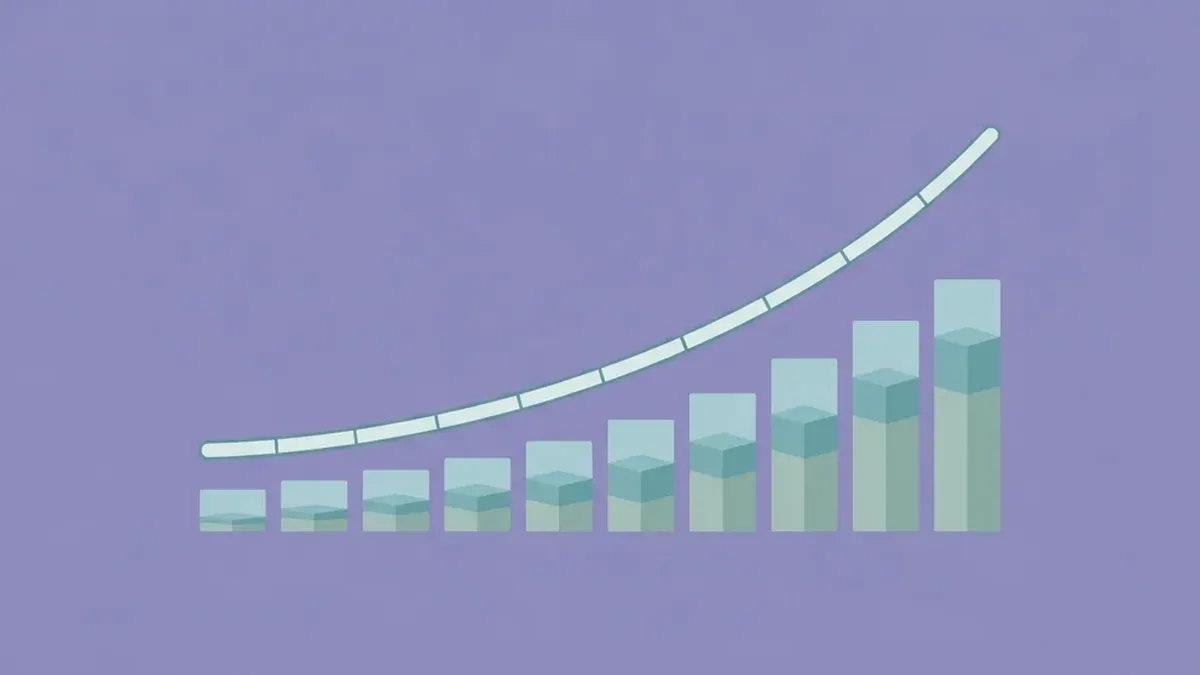
A Roth IRA funded with consistent contributions and reasonable investment returns can grow significantly over a decade. The exact amount depends on how much you contribute, how your investments perform, and how long you let compound interest work.
Run the numbers with the free Roth IRA calculator on ezcalcs, then come back to this guide for context. Results are estimates for planning only.
This guide walks through realistic growth scenarios, explains why tax-free compounding gives Roth IRAs an edge, and covers strategies to maximize your retirement savings over a 10-year window.
How a Roth IRA Grows Over 10 Years
A Roth IRA grows through two forces: your contributions and the investment returns those contributions generate. You put in after-tax dollars, and the money inside the account compounds without being reduced by annual taxes on dividends, interest, or capital gains.
Over 10 years, even modest contributions add up. If you contribute $500 per month at a 7% average annual return, your Roth IRA balance would reach roughly $86,000 after a decade. About $60,000 of that is your own money. The remaining $26,000 is investment growth.
Bump that to the current maximum contribution ($7,000 per year, or about $583 per month), and you're looking at approximately $100,000 after 10 years at the same 7% return. These are estimates. Actual results depend on market performance, which varies year to year.
How much will $10,000 invested be worth in 10 years? A single $10,000 lump sum growing at 7% annually would be worth roughly $19,670 after 10 years. At 10%, it would reach about $25,940. The rate of return matters enormously over a full decade.
Roth IRA Contribution Limits and Their Effect on Growth
The IRS sets a cap on the amount you can contribute to a Roth IRA each year. For 2024 and 2025, the contribution limit is $7,000 if you're under 50. If you're 50 or older, you get an extra $1,000 catch-up contribution, bringing the limit to $8,000.
These limits directly shape how much your account can grow. Maxing out every year gives compound interest a larger base to work with. Missing even a single year means lost compounding time you can't recover.
Here's how contribution consistency affects 10-year growth at a 7% annual return:
- Max contributions ($7,000/year for 10 years): approximately $96,700
- $5,000/year for 10 years: approximately $69,100
- $3,000/year for 10 years: approximately $41,400
- $1,000/year for 10 years: approximately $13,800
These figures assume contributions made at the start of each year. Contributing earlier in the year gives your money more time to grow.
Wondering how much to put in a Roth IRA per month? Dividing the $7,000 annual limit evenly works out to about $583 per month. If that feels steep, start with what you can and increase over time. Any consistent contribution beats zero.
Investment Returns and Rate of Return Scenarios
The average annual return of the S&P 500 has been roughly 10% over long periods before adjusting for inflation. After inflation, that number drops closer to 7%. Most financial planning models use something between 6% and 8% as a reasonable estimate for a diversified portfolio.
Your actual rate of return depends on what you invest in. A Roth IRA is a container, not an investment itself. You choose what goes inside: index funds, individual stocks, bonds, or target-date funds.
What is the average 10-year return on a Roth IRA? There isn't one universal number because it depends on your investment mix. But a portfolio heavy in U.S. stock index funds has historically returned about 10% per year before inflation over most rolling 10-year periods. Some decades are better, some worse.
Here's how a $7,000 annual contribution looks after 10 years at different return rates:
| Annual Return | Balance After 10 Years | Total Contributions | Total Growth |
|---|---|---|---|
| 4% | ~$84,000 | $70,000 | ~$14,000 |
| 7% | ~$96,700 | $70,000 | ~$26,700 |
| 10% | ~$111,600 | $70,000 | ~$41,600 |
The difference between 4% and 10% is nearly $28,000 in extra growth on the same contributions. That's why your investment choices inside the Roth IRA matter as much as contributing consistently.
A market crash in the middle of your 10-year window will dent short-term performance. But historically, staying invested through downturns has rewarded patient investors. Ten years is long enough to recover from most corrections, though it's not guaranteed.
Tax-Free Earnings: Why Your Roth IRA Compounds Faster
The single biggest advantage of a Roth IRA is tax-free growth. Because contributions are funded with after-tax dollars, qualified withdrawals in retirement come out completely tax-free. That includes all your earnings, not just your original contributions.
In a taxable brokerage account, you owe taxes on dividends, interest, and capital gains every year. Those taxes chip away at your compounding base. In a Roth IRA, every dollar of growth stays invested and keeps compounding.
Over 10 years, this tax advantage can mean thousands of extra dollars. For someone in the 22% tax bracket investing $7,000 per year at a 7% return, the tax drag on a taxable account could reduce the final balance by roughly $3,000 to $5,000 compared to the same investments inside a Roth IRA.
Tax Deduction Differences That Affect Your Retirement Account
A traditional IRA gives you a tax deduction upfront. You pay taxes later when you withdraw in retirement. A Roth IRA works the opposite way: you pay taxes now and withdraw tax-free later.
This means a Roth IRA doesn't reduce your current tax bill. But it eliminates future tax liability on all that growth. If you expect to be in a higher tax bracket in retirement, or if you believe tax rates will rise under future tax laws, the Roth approach can save you more over time.
There's another subtle benefit. With a traditional IRA, your required minimum distributions (RMDs) push your retirement income higher, potentially increasing taxes on Social Security benefits. Roth IRAs have no RMDs during the owner's lifetime, giving you more control over your tax situation in retirement.
Withdrawal Rules and Tax-Free Growth
Roth IRA withdrawal rules are more flexible than most retirement accounts, but there are limits.
- Contributions: You can withdraw your original contributions anytime, at any age, with no taxes or penalty.
- Earnings: To withdraw earnings tax-free and penalty-free, you must be at least 59½ and the account must be at least five years old (the "five-year rule").
- Early withdrawal of earnings: If you pull out earnings before meeting both conditions, you'll typically owe income tax plus a 10% penalty. Some exceptions apply, like a first-time home purchase (up to $10,000).
This flexibility makes the Roth IRA a useful savings tool even before retirement. Knowing your contributions are accessible can provide peace of mind, though leaving the money invested maximizes long-term growth.
Roth IRA vs. Traditional IRA for 10 Year Growth
Both Roth and traditional IRAs let your investments grow without annual tax drag. The core difference is when you pay taxes.
Over a 10-year window, the pretax balance of a traditional IRA will look larger because you haven't paid taxes on it yet. But that number is misleading. A portion of every traditional IRA dollar belongs to the IRS. A Roth IRA balance is yours entirely.
Here's a simplified comparison for someone contributing $7,000 per year at a 7% return for 10 years:
- Traditional IRA balance: ~$96,700 (but future withdrawals taxed as income)
- Roth IRA balance: ~$96,700 (withdrawals are tax-free)
If you're in the 22% bracket at withdrawal, the traditional IRA's after-tax value drops to roughly $75,400. The Roth IRA stays at $96,700. That's a meaningful difference.
How Your Tax Bracket Shapes the Decision
The Roth vs. traditional choice comes down to your tax bracket now versus your expected bracket in retirement.
- Lower bracket now, higher later: Roth IRA wins. You pay taxes at a low rate today and avoid higher rates in the future.
- Higher bracket now, lower later: Traditional IRA may win. You get a bigger tax deduction today and pay at a lower rate when you withdraw.
- Same bracket: Roth IRA usually has a slight edge because of the RMD flexibility and the certainty of tax-free withdrawals.
For younger earners early in their careers, a Roth IRA is often the stronger choice. Your current income (and tax rate) is likely at its lowest. Locking in today's rates on decades of future growth can be a significant financial advantage.
Income Limits and Eligibility
Not everyone can contribute directly to a Roth IRA. The IRS imposes income limits based on your modified adjusted gross income (MAGI).
For 2024:
- Single filers: Full contribution allowed below $146,000. Phased out between $146,000 and $161,000. No direct contribution above $161,000.
- Married filing jointly: Full contribution below $230,000. Phased out between $230,000 and $240,000.
If your income exceeds these limits, you may still be able to use a backdoor Roth IRA strategy (contributing to a traditional IRA, then converting). This is legal under current tax laws, but it involves extra steps and potential tax implications. A financial advisor or tax professional can help you navigate it.
Traditional IRAs have no income limit for contributions, though the tax deduction may be limited if you or your spouse has a workplace retirement plan.
Using a Roth IRA Calculator to Estimate Your Growth
A Roth IRA calculator helps you model different scenarios quickly. You enter your starting balance, monthly or annual contributions, expected rate of return, and time horizon. The calculator shows your projected account balance and how much of it comes from growth versus contributions.
These tools are useful for setting realistic financial goals. They show the power of compound interest in concrete dollar terms, which can motivate consistent saving.
Keep in mind that every calculator uses simplifying assumptions. Most assume a fixed annual return, which doesn't happen in real markets. Actual returns fluctuate. A calculator gives you a planning estimate, not a guarantee.
How an IRA Calculator Models Compound Interest
How does compound interest work with a Roth IRA? The basic formula is straightforward. Each year, your balance grows by the rate of return. The next year, that growth earns its own returns. Over time, the growth-on-growth effect accelerates.
Here's a simple example with a $10,000 starting balance and no additional contributions at 7%:
- Year 1: $10,700
- Year 5: $14,026
- Year 10: $19,672
- Year 20: $38,697
How much will $10,000 in a Roth IRA be worth in 20 years? At 7%, roughly $38,700. At 10%, about $67,300. The later years produce the biggest gains because the base keeps growing. That's why starting early matters so much.
Most IRA calculators also let you adjust for inflation, which gives you a clearer picture of your money's future purchasing power.
Build Wealth With Consistent Roth IRA Contributions
The most reliable way to build wealth with a Roth IRA is simple: contribute consistently, invest in diversified funds, and don't withdraw early. Time in the market matters far more than timing the market.
Even if you can't max out your contributions, regular investing builds momentum. Someone who contributes $200 per month for 10 years at 7% ends up with about $34,500. That's $24,000 of their own money plus $10,500 in growth.
Automating your contributions removes the decision each month. Set up an automatic transfer from your bank to your Roth IRA on payday. You'll adjust to spending without that money faster than you expect.
Retirement Savings at Every Age
How does your Roth IRA compare to others? Average IRA balances vary widely by age, but benchmarks can help you gauge your progress.
- 20s: Most people are just starting. Even $5,000 to $15,000 puts you ahead of the average.
- 30s: A balance of $30,000 to $60,000 shows consistent saving. This is when compounding starts to become visible.
- 40s: $80,000 to $150,000 is a reasonable target. If you're behind, the catch-up contribution (available at 50) helps.
- 50s and beyond: $200,000+ is ideal, though many Americans have less. The $8,000 annual limit (with catch-up) makes aggressive saving possible.
These are rough guideposts, not rigid targets. Your retirement needs depend on your spending, other retirement plan income (like a 401k), and when you plan to stop working.
What other retirement accounts can you use with a Roth IRA? Many people pair a Roth IRA with a workplace 401(k). Contribute enough to the 401(k) to capture any employer match, then fund your Roth IRA, then go back and increase 401(k) contributions if you have more to invest. This gives you both pre-tax and after-tax retirement savings, which provides flexibility when managing taxes in retirement.
Personal Finance Strategies to Maximize Your Retirement Account
Growing your Roth IRA isn't just about choosing the right investments. A few personal finance habits can significantly boost your results over 10 years.
- Contribute early each year. Investing $7,000 in January instead of December gives it 11 extra months to compound. Over 10 years, this can add hundreds of dollars in extra growth.
- Reinvest all dividends. Make sure dividends and capital gains distributions buy more shares automatically. This accelerates compounding.
- Increase contributions when your income rises. Got a raise? Direct part of it to your Roth IRA before lifestyle inflation absorbs it.
- Avoid unnecessary withdrawals. Even though you can pull out contributions penalty-free, every dollar removed is a dollar that stops compounding.
How much does a Roth IRA grow in a year? In a typical year with a diversified stock portfolio, you might see 7% to 10% growth. But individual years vary wildly. Some years you'll gain 20%. Others you'll lose 15%. The 10-year average smooths these swings, which is why a longer time horizon reduces risk.
Choosing the Right Investment Mix
Your investment mix inside the Roth IRA has a bigger impact on growth than almost any other factor.
For a 10-year or longer time horizon, most financial planning guidance suggests a stock-heavy allocation. A common approach:
- Younger investors (20s to 40s): 80% to 90% stocks (broad index funds), 10% to 20% bonds
- Closer to retirement (50s and 60s): 60% to 70% stocks, 30% to 40% bonds
Target-date retirement funds automate this shift. You pick the fund closest to your expected retirement year, and it gradually becomes more conservative. They're a solid default for anyone who prefers simplicity.
Avoid holding too much cash or overly conservative investments inside a Roth IRA, especially if you have decades until retirement. The tax-free growth benefit is most powerful when applied to higher-return investments like stocks.
When to Talk to a Financial Advisor About Your Roth IRA
For straightforward situations (steady income, no complex tax issues, basic index fund investing), you can manage a Roth IRA on your own. Plenty of people do.
But some situations benefit from professional guidance:
- Your income is near the Roth IRA eligibility limits and you're considering a backdoor conversion
- You're deciding between a Roth IRA conversion ladder and keeping money in a traditional IRA or 401(k)
- You're approaching retirement and need to coordinate withdrawals across multiple accounts
- You want a comprehensive financial plan that accounts for taxes, estate planning, and Social Security timing
- You have a custodial Roth IRA for a child and want to understand the long-term implications
A fee-only financial advisor or financial planner who acts as a fiduciary is generally the safest choice. They charge for advice rather than earning commissions on products.
Nothing in this guide is tax advice or financial advice. These are planning estimates based on historical returns and current tax laws, both of which can change. For decisions involving your specific situation, consult a qualified tax professional or financial advisor.